
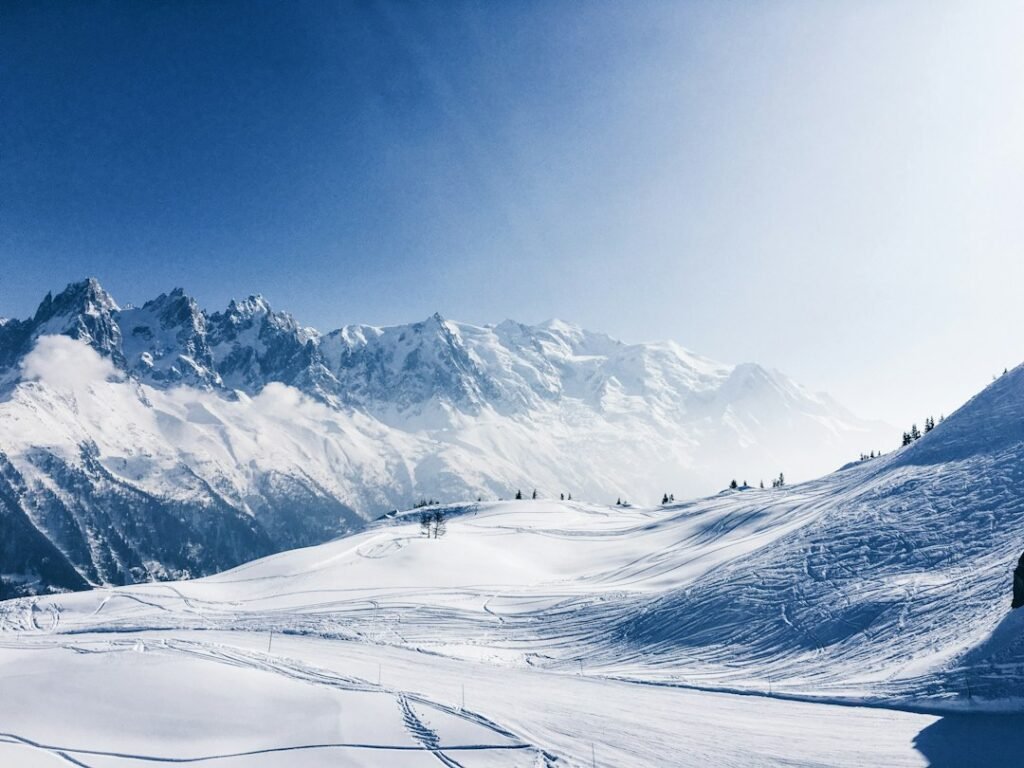
Is Chamonix the right ski resort for you?
Choose Chamonix for a holiday across several distinct mountains, not for one enormous ski-in/ski-out resort. Brévent–Flégère, Grands Montets, Balme and Les Houches have different access points and terrain. The practical choice is which of those areas you want to use most, then where to stay.
Beginners do have dedicated learning areas, including Savoy, Les Planards and La Vormaine. But a first-timer based beside their chosen nursery slope will have a different week from someone commuting across the valley to lessons. This guide explains those differences rather than treating every Chamonix address as interchangeable.
Resort, pass and transport information checked against the linked official sources on 22 October 2026. Winter 2026–27 opening dates are planned dates, subject to conditions.
How the Chamonix ski areas fit together
You cannot ski continuously from Les Houches through Chamonix to Grands Montets and Le Tour. These are separate areas reached from different villages. Brévent and Flégère are the exception: they have a lift connection, when operating. A broad lift pass does not turn the rest of the valley into a connected piste circuit; the operator’s pass information makes that distinction explicit.
For a first visit, plan one principal ski area per day. That avoids losing the middle of the day descending, changing transport and going up a different mountain. The official valley ski-area directory links to both a winter valley map and an interactive piste map. Our Chamonix map page helps with resort location, but is not a substitute for those operational maps.
Brévent and Flégère: which base should you use?
Use the Brévent side from Chamonix town, or the Flégère gondola from Les Praz. The tourism office places Les Praz about 3 km from central Chamonix. Both sectors face the Mont Blanc massif on the sunny, south-facing side of the valley. The Brévent–Flégère area guide gives access points, lift dates and current pass information.
For accommodation, that creates a useful distinction: a Les Praz address can suit someone repeatedly heading to Flégère, whereas a central Chamonix address may suit a group starting at Brévent. Neither location puts Grands Montets outside the front door. When the connecting lift is closed, treat the two sides as separate outings rather than assuming you can cross and return on skis.
Grands Montets, Balme and Les Houches: what is different?
Grands Montets, above Argentière
Grands Montets is the mountain to investigate when a substantial part of your trip will be spent around Argentière. There is an important infrastructure distinction for winter 2026–27: the official resort listing announces an Argentière–Lognan gondola for Christmas 2026, but the replacement summit cable car is scheduled for winter 2027–28. Do not plan a 2026–27 holiday around old descriptions of lift access to the summit. Check the live opening report for the actual facilities available.
Balme, reached from Le Tour or Vallorcine
Balme offers two different sides: open slopes around Charamillon above Le Tour, and forested terrain towards Vallorcine. The official Balme guide identifies both village access points. For an improving skier, this is worth comparing with a Grands Montets-focused trip. Complete beginners should distinguish the mountain area from La Vormaine’s separate learning slopes at Le Tour.
Les Houches–Saint-Gervais
Les Houches has its own ski area, rather than a piste connection to Brévent or Argentière. It is a useful base to consider when your lessons and skiing will be concentrated locally: the beginner area above the Prarion gondola includes a conveyor and access to the green Ecole run. Use the valley’s beginner-area guide to locate it, and the Les Houches ski-area page for its own map and operating information.
Is Chamonix a sensible beginner destination?
Yes, provided you choose a specific learning area and stay within easy reach of it. It is not necessary to tackle the higher mountain sectors to learn here. The compromise is that moving between the valley’s different areas takes more planning than staying beside a single resort snow front.
In Chamonix town, start with Savoy or Les Planards. Savoy is at the foot of Brévent, with gentle slopes, two ski lifts and a free conveyor. Les Planards, near the town centre, is another established learner option. These are concrete alternatives to booking a hotel beside a high-mountain lift and assuming the first lesson starts there.
At Le Tour, look at La Vormaine. Its official learning-area page describes wide, gentle slopes at the foot of Balme. Around Argentière, Les Chosalets provides another small beginner area; Les Houches has Le Tourchet in the village as well as the Prarion option described above. The tourist office’s beginner guide locates these areas and links to local ski schools.
The useful booking sequence is therefore: choose the learner area, arrange the lesson there, then choose accommodation and the required pass. For the rest of the first-trip checklist, see our beginner holiday guide.
Staying in Chamonix town versus the valley villages
Chamonix town: a sensible starting point when your group wants to visit different sectors rather than concentrate on one. Prioritise the actual walk to Brévent, Savoy, Planards or a useful bus stop. Being central does not mean being able to ski home from every mountain.
Les Praz: consider it when access to Flégère is the priority. The trade-off is being outside the main town centre, so compare the accommodation’s gondola access with your evening travel plans.
Argentière: the official village guide places it 8 km north of Chamonix, at around 1,250 metres, and identifies Grands Montets as its main skiing draw. Choose it for a trip centred on that end of the valley, not because a listing describes it broadly as Chamonix.
Les Houches: worth considering for a family staying around its own skiing and beginner facilities. Compare addresses near Prarion with those closer to the village and Le Tourchet. The Les Houches village page provides local facilities and accommodation links; trips to the northern valley sectors still require transport.
Le Tour or Vallorcine: these make more sense when Balme or La Vormaine is central to your plans. Vallorcine is the quieter village near the Swiss border, with its own gondola into Balme and a Mont-Blanc Express station. It is a different proposition from staying in Chamonix town and walking out for the evening.
Mountain buses and trains: how do you get back?
Use Chamonix Mobilité for buses and the Mont-Blanc Express for village-to-village rail travel. The tourism office’s transport page links to current network maps and timetables. It also explains the rail connections through Les Houches, Chamonix, Les Praz, Argentière and Vallorcine. A station serving a village is not necessarily beside your chosen lift.
There is an easily missed fare distinction. A valid accommodation guest card gives free Mont-Blanc Express travel between Servoz and Vallorcine, but the guest card alone is not a bus ticket. It gives access to specified bus discounts; you need the appropriate ticket or qualifying valid lift pass. Read the guest-card transport conditions rather than assuming every journey is free.
Before leaving for a different sector, check the return service to your actual accommodation. As of this review, the linked bus guide covers 7 September–18 December 2026: it should not be used as a timetable for a January holiday. Use the current winter schedule when it is published.
Which lift pass should you buy, and what does it cost?
Start with where you will ski, then compare passes. The published Chamonix Le Pass coverage includes Brévent–Flégère, Balme and Grands Montets. The broader Mont Blanc Unlimited product also lists Les Houches–Saint-Gervais and sightseeing attractions, with conditions that depend on duration. It is not automatically better value for a learner spending the week in one small area.
For a concrete price reference, the official 2026–27 tariff listing gives an adult Chamonix Le Pass day ticket at €76.50 for 19 December 2026–9 April 2027. That is a dated published day rate, not a quote for a whole holiday or a substitute for checking multi-day and online offers. Local beginner tickets, lessons, equipment and accommodation need pricing separately.
Ask your ski school which ticket its lesson requires before buying a full-area pass. For a broader comparison of included and excluded costs, use our ski holiday package guide.
When does Chamonix open for winter 2026–27?
There is no single opening date for the whole valley. The official opening forecast, checked on 22 October 2026, lists Grands Montets and Flégère from 28 November, Brévent and Balme from 12 December, and Les Houches from 19 December. All are subject to snow conditions; a first opening may be partial or limited to particular days.
Those dates do not establish that Savoy, Planards or another nursery area will open at the same time. For an early-season beginner trip, check the chosen learner area’s own calendar. For spring, do the same with its closing date rather than relying on the last operating date of a higher mountain sector. The official live report also links to webcams and lift status for near-term decisions.
Getting to Chamonix from Britain
Geneva is the airport to investigate first for a flight-and-road-transfer trip. The official access guide lists it 88 km away and identifies scheduled coaches and airport shuttle services. Choose a transfer to your actual village: an arrival at Chamonix-Sud is not the same as a drop-off at an apartment in Argentière or Vallorcine.
For rail travel, the key interchange is Saint-Gervais-les-Bains–Le Fayet, where the Mont-Blanc Express connects into the valley. The access guide links to SNCF journey planning and Léman Express. Compare the complete itinerary for your dates instead of assuming a direct airport-to-resort train. Winter flight schedules and onward connections must be booked as an actual journey, not inferred from proximity on a map.
Frequently asked questions
Can you ski between all the Chamonix ski areas?
No. Brévent and Flégère are linked when the connection operates; travelling to the other main valley areas requires a separate journey. Choose a ski area for the day rather than assuming one continuous piste network.
Where should a complete beginner learn in Chamonix?
Savoy and Les Planards are options around Chamonix town; La Vormaine is at Le Tour. Les Chosalets and the Les Houches learning areas are alternatives elsewhere in the valley. Choose accommodation around the actual lesson location.
Does the guest card give free bus travel?
Not by itself. The guest card provides specified bus discounts and free train travel between Servoz and Vallorcine. A bus journey requires the appropriate ticket or qualifying valid lift pass.
Is Argentière the same place as Chamonix town?
No. It is a separate village about 8 km north of central Chamonix, associated with access to Grands Montets. That location is useful for some ski plans but should not be confused with staying in the town centre.
Compare Chamonix on the SlopeFinder map, read our non-skier destination comparison, or browse the other ski guides.
Explore resorts on SlopeFinder
Save your favourite resorts and compare the destinations that suit your dates and travel plans.
Explore the interactive resort mapBefore booking, confirm live availability, lift operations, transfers and what the final price includes.